Every March, we celebrate the women who changed history. Some of them were bold and brilliant. Some were flawed. And some are still out there right now, doing the work.
When it comes to Women’s History Month birth control history, the story is messy, complicated, and worth knowing. Because the freedom you have today: to choose your birth control, to say no to hormones, to be in control of your own body, didn’t just happen. Women made it happen.
The Legend: Margaret Sanger
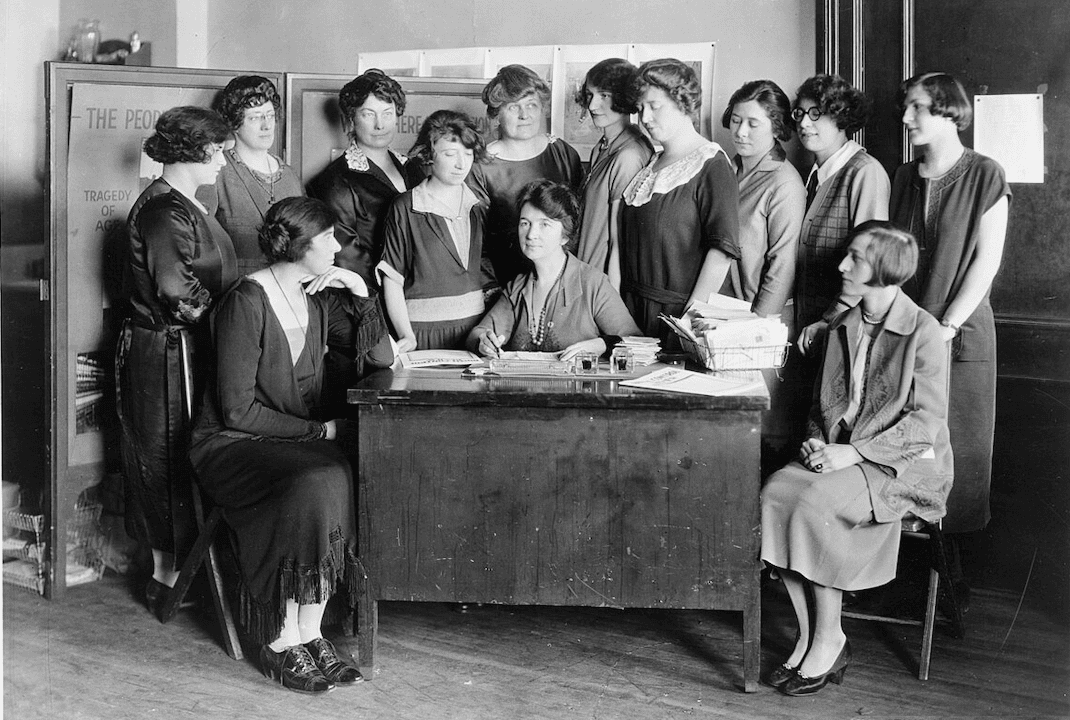
You can’t talk about birth control history without Margaret Sanger. In 1916, she opened the first birth control clinic in the United States in Brooklyn, New York. She was arrested for it. She did it again. She helped found what eventually became Planned Parenthood. She spent decades fighting to make contraception legal and accessible. (Image above features: Margaret Sanger, half-length portrait, seated behind desk, surrounded by twelve other women, Underwood & Underwood Studios, N.Y.)
But here’s the truth: Sanger’s legacy is complicated. She held eugenicist views and supported policies that targeted Black women, poor women, and immigrant women. These were the very women who most needed reproductive autonomy. Her advocacy opened doors, and it also caused real harm.
We need to acknowledge successes and failings in order to build stronger.
The Builders: Women Who Pushed the Science Forward
In 1960, the FDA approved the first birth control pill. Behind that approval were researchers, scientists, and countless women who volunteered for clinical trials. Many of them were in Puerto Rico, where oversight was limited and women were not always fully informed of the risks. Their participation made the pill possible.
Decades later, a different group of women took a seat at the table. In the 1990s, researchers at PATH began asking women around the world what they actually wanted in a birth control method. The answer was clear: more control, fewer side effects, something designed for their bodies. That research eventually led to the development of the Caya contoured diaphragm. Shaped with input from women, tested by women, and sized to fit 97.6% of women. No fitting required. No daily pill. No hormones.


The Advocates: Doing the Work Right Now
History isn’t just the past. In Richmond, Virginia, Birth in Color RVA has been championing maternal health and reproductive justice since 2018. Founded by Kenda Sutton-EL, the organization provides culturally centered doula care, training, and advocacy. They specifically address the reality that Black women are three to four times more likely to die in childbirth than white women.

This year, their advocacy helped push landmark legislation across Virginia’s finish line. Among the wins headed to Governor Spanberger (and the first female governor for the state!) for her to hopefully pass: mandatory insurance coverage for doula care, Medicaid expansion for birth workers, maternal mental health screenings, and SB361. That last one requires health insurers to cover contraceptive drugs and devices with zero copays. Reproductive freedom, made more accessible for more women.
And in what may be the most significant milestone of all: both chambers of the Virginia legislature passed the Reproductive Freedom constitutional amendment. It now heads to Virginia voters in November 2026.
This is what righting historical missteps looks like. Not erasing the complicated past, but building something better on top of it.
The Everyday Champions
Change also happens one appointment at a time. Providers across the country are quietly expanding what’s possible for their patients. A healthcare provider, Stephanie Langsam aka Dr. Blooms, in Pennsylvania recently shared an unboxing of Caya patient and provider materials on Instagram. It’s the kind of moment that doesn’t make headlines but matters enormously to the women who walk into that office and finally hear about an option they didn’t know existed.


Where You Fit In
You are part of this story. Every time you ask your provider about hormone-free options, every time you share information with a friend, every time you choose birth control that actually works for your body, you are participating in something women have been fighting for over a century.
Caya is one option in that fight. Woman-designed, hormone-free, and built to fit. You can learn more about getting Caya through your provider or via telehealth. And if you want to dig into how the modern diaphragm came to be, our page on the women who shaped Caya’s design tells that story well.
The legends did their part. The work continues.
The information included in this blog post is accurate as of publication. For the most current details about Caya, or if you have specific questions about your contraception options, please visit our FAQ at Caya.US.com or consult with your healthcare provider.